
Here’s a way to communicate “I’m busy” in immersive environments
Early today I published an article about a recent lightbulb moment: you’ve got to stay logged into the immersive environment where your tribe hangs out to get those serendipitous interactions that usually only occur when people are physically together in the same place. (See the ThinkBalm article, Lightbulb moment: for serendipity, stay logged into the immersive environment.) What I didn’t write about in that article is one of the challenges of staying logged in indefinitely: just because you’re logged in it doesn’t mean you’re available to converse with others.
In the physical world, you can be in the office and close your door when you don’t want to be disturbed. People can look through the window to see that you are meeting with someone or on the phone or knee-deep in paperwork. You can let phone calls go into voice mail. You can turn on your “out of office” message if you think it will be a while before you’ll be responding to email messages. But in an immersive environment, there is no standard protocol for letting others know you’re “sort of there” — you’re there but not available. The most common indicator is the head-down / arms-hung “AFK” pose that avatars take in Second Life and OpenSim when the user hasn’t touched the keyboard or mouse for a while.
So I took a shot at it. In the ThinkBalm Innovation Community space on ReactionGrid, an OpenSim grid, I created a simple space that serves as the immersive equivalent of a combined closed office door, voice mail box, and out of office message (see figure below). When I am logged into ReactionGrid but busy or away from my desk I’m going to try putting my avatar in this designated location, which is centrally located and easy to see. Partial walls are translucent so people can see that my avatar is in there. A sign outside says, “Hi! If you see Erica Driver’s avatar sitting here it means I’m on the phone or in a meeting. You can leave me a public text-based message by clicking here.” The visitor can click on the sign to go an EtherPad I set up on the Web. There they can leave me a text-based note, similarly to the way one might write a note on a whiteboard attached to an office or dorm room door. The EtherPad also contains my email address in case visitors don’t want to leave a publicly-displayed message.
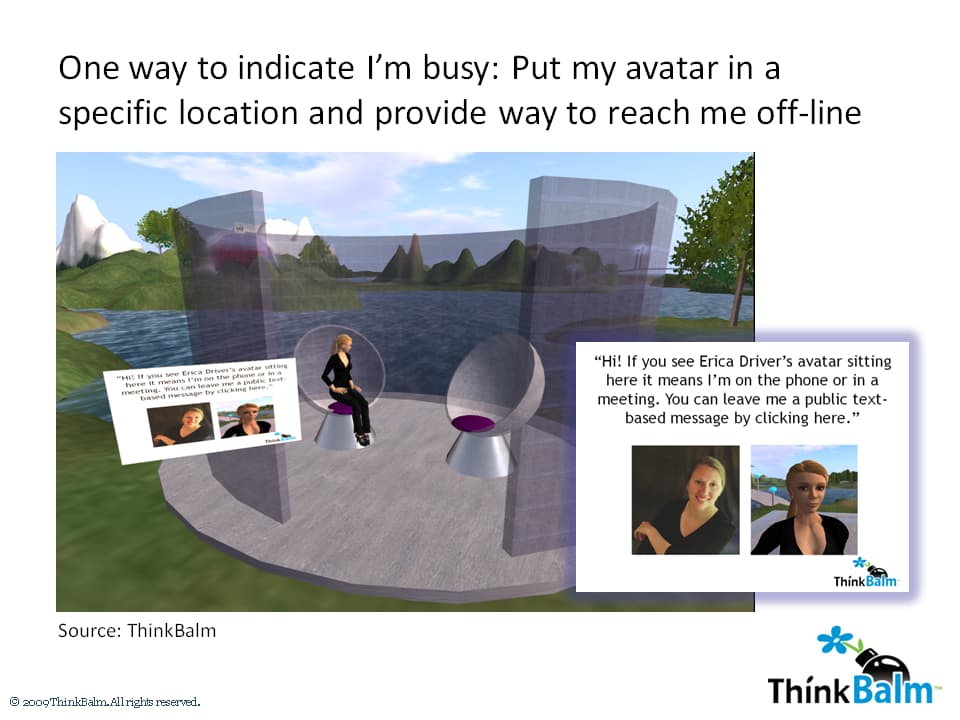
I am at the beginning of a one- or two-week experiment to stay logged into this immersive environment whenever I am at my computer in an effort to strengthen my relationships with ThinkBalm Innovation Community members and learn some new things about using this emerging technology in the work context. Things I’m wondering about right now:
-
There are so many technology options. I use various immersive environments for ThinkBalm Innovation Community activities and my work with ThinkBalm clients — not just ReactionGrid. And ReactionGrid is not the only place ThinkBalm Innovation Community members “pop in” — many also pop into Second Life. What is the impact of this fragmented market on my ability to benefit from serendipitous interactions with the people who matter most to me, or who I’d like to get to know better?
-
Managing another form of presence info might be tedious. Will it become too onerous to remember to move my avatar to my “I’m busy” spot when I’m no available? Given how hard it is to remember to set instant messaging presence information to “away” or “do not disturb,” or to turn or off email out of office messages, I suspect the answer might be yes.
-
Will I get enough value out of these unplanned interactions? Will the effort be worthwhile? I suspect the answer is yes, but don’t have evidence for that yet. We’ll see how it goes! I’ll write again about this experiment during the next couple of weeks. Do check back.

